
Defense Victory: Fifth DCA Reverses Verdict Against Hotel Management Company
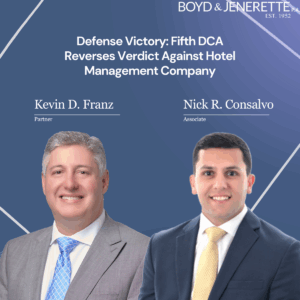
Kevin D. Franz and Nicholas R. Consalvo successfully obtained a decision from the Fifth District Court of Appeal reversing a $280,000 verdict in an action involving a negligent supervision and training claim brought against a hotel management company. Plaintiff's negligence action sought damages for injuries he alleged were caused during a physical altercation with a hotel employee. Plaintiff brought claims against both the hotel employee, individually, and the hotel management company, as the corporate employer, alleging various theories of direct and vicarious liability.
Liability, causation, permanency, and damages were highly disputed during trial. The defense also presented evidence that the employee had acted in self-defense and that Plaintiff was comparatively negligent. At the close of evidence, the defense moved for directed verdict on the direct negligence claim brought against the corporate employer for the negligent supervision and training of its employees. The defense argued that based on the employer's admission that its employees were all acting in the course and scope of their employment at the time of the subject incident, the direct negligence claim was improper because it asserted a concurrent theory of recovery that was duplicative of Plaintiff's vicarious liability claims. The trial court denied the employer's motion for directed verdict. The jury found there was no negligence on the part of the employee that was a legal cause of damage to Plaintiff. The jury separately found, however, that both the employer and Plaintiff were negligent; assessing Plaintiff to be 80% at fault and the employer to be 20% at fault.
Plaintiff subsequently appealed the trial court’s denial of his post-trial motion for new trial or additur, arguing the damages awarded by the jury's verdict were inadequate and against the manifest weight of the evidence. We then cross-appealed on behalf of the corporate employer. In the cross-appeal, we argued that while the employer could be vicariously liable for the actions of its employees done within the scope of their employment, it could not, as a matter of law, be separately liable for damages under Plaintiff's negligent supervision and training claims where the undisputed evidence was that none of its employees had acted outside the course and scope of their employment.
The Fifth District Court of Appeal agreed with the defense position in the cross-appeal and held that the trial court erred in failing to grant the employer's motion for directed verdict on the negligent supervision and training claim. The Fifth District reasoned that Plaintiff presented no evidence at trial that any actions taken by either of the employer's two managers on duty were done outside the course and scope of their respective employment, which is necessary for the employer to be separately liable for damages for negligent supervision or negligent training. The Fifth District's analysis acknowledged the distinction that exists under Florida law for how negligent employment claims brought against a supervisor individually, as opposed to those brought solely against a corporate employer, are not dependent on whether the subordinate employee’s actions were outside the scope of employment. However, the Fifth District found that principle to be inapposite in this case, because Plaintiff never sued the employer's acting general manager or front desk manager in their individual capacity.
As a result of its disposition of the cross-appeal, the Fifth District reversed the final judgment entered in favor of Plaintiff and remanded with directions for the trial court to enter final judgment in favor of the corporate employer.

Kevin D. Franz
Partner
Direct: 954.622.0093
Email: kfranz@boydjen.com
Kevin D. Franz[spacer height="-15px"]
[spacer height="-20px"]Kevin D. Franz is a partner and Practice Group Leader of the firm’s Appellate Practice division. Mr. Franz has been Board Certified in Appellate Practice by The Florida Bar since 2019. He has received the Martindale-Hubbell AV Preeminent® Peer Review Rating and has 20 years of experience handling all types of civil appellate proceedings. Mr. Franz has handled appeals and petitions in the Supreme Court of Florida, the six District Courts of Appeal for the State of Florida, and the United States Court of Appeals for the Eleventh Circuit.

Nicholas R. Consalvo
Associate
Direct: 561.287.7236
Email: nconsalvo@boydjen.com
Nicholas R. Consalvo[spacer height="-15px"]
[spacer height="-20px"]Nicholas R. Consalvo joined Boyd & Jenerette in May 2023 as an associate with the Appellate Practice division, working remotely from Tampa, Florida. Prior to joining Boyd & Jenerette, Nick also practiced with a civil litigation firm in Tampa, Florida, handling a range of matters, including litigating claims involving breach of contract, fraud, deceptive and unfair trade practices, trade secrets, and various business torts involving franchise agreements, class action lawsuits, commercial and residential landlord-tenant actions, and construction disputes. In addition to his commercial litigation practice, Nick briefed multiple cases before the United States Court of Appeals for the Eleventh Circuit and Florida District Courts of Appeal.